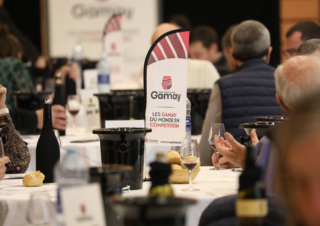
There are many occasions where you might taste test wine, whether it’s at a restaurant, at a friend’s house, during a family dinner or at a trade fair. Do you find this a bit daunting, maybe more intimidating than fun? Here are some recommendations from a wine tasting expert to help you get to grips with this practice. The goal? To learn the basics and feel more confident when taste testing wine, because ultimately, only one thing matters: your own preferences!

Méven Otheguy, wine tasting specialist
Méven Otheguy is a researcher specialised in wine tasting in the sensory unit of the Sicarex Beaujolais / IFV (The French Wine and Vine Institute). His job involves studying the practice of wine tasting, by both enthusiasts and professionals, from every angle.
In this blog post, our wine tasting expert shares the basic principles of wine tasting and some of his recommendations.
Three basic tips when taste testing wine
1. Take the wine out of the fridge or wine cellar before
The temperature at which a wine is served is really important in the tasting process. So you must try to get it to the ideal temperature by taking the bottle out of the fridge or wine cellar at the right time.
“Drunk too warm, a red wine may seem heavy, alcoholic, difficult to drink. Conversely, if it’s too cold, it might seem closed.”
explains Méven Otheguy, expert in sensory analysis.
Note:
- The ideal drinking temperature for red wine is between 12 and 16°C
- For white wine it is 8-9°C and up to 12-13°C maximum
- Ideally, white and rosé wines should be taken out of the fridge around half an hour before opening the bottle

Uncork the bottle beforehand
After having spent months or even years in a container with no oxygen, wine needs to be in contact with air to open up. Depending on how old the bottle is, it can be opened beforehand so the wine can breathe. The wineglass itself will also allow this. It’s important to note that the wider a glass, the more the wine will be able to breathe.
In terms of amount, we generally pour between 2 and 4 centilitres into a glass. “This allows us to take two or three sips to properly appreciate the wine,” according to our wine tasting expert.
3. Taste the wines in the correct order
If you are tasting several wines, make sure to start with the lightest wine and move towards the densest (the alcohol content stated on the label can be a good indicator).
Are there several different colours in your selection? Start with the rosés, then move to the whites and finish with the reds. So as not to saturate your palate or ingest too much alcohol, you can spit between each sample.
If you don’t have a spittoon, it is perfectly fine for each participant to use a cup! It is important that everyone pays attention to how they feel and allow themselves breaks between tastings. When it comes to eating or drinking between glasses of wine, Méven Otheguy says, “there are no rules. Everyone should be given the option to do so, by providing a jug of water, unsalted crackers or some bread.”

To learn more about wine tastings as performed by professionals: “Taste test wines like a professionas”

Three tips for a better tasting experience
Choose the right time
Yes, your wine tasting experience will be better at some times of the day than others. According to our sensory expert, “it’s better to do it when you’re hungry, because your senses are on high alert”. The ideal time to open a bottle or visit a winemaker’s cellar is in the late morning, between 10am and 12pm. One, because you won’t be feeling the tiredness that usually comes at the end of the day and two, it will have been a few hours since you brushed your teeth or drank coffee, so it won’t interfere with your tasting experience. However, if you do want to do a wine tasting in the evening, it’s best to do it before you have eaten.


Set the mood
While they may not often be taken into account, context and emotions greatly influence tasting experiences. The light, the music, the people you’re with, the mood you’re in… all this can affect the way you perceive wine. Has a wine you adored on holiday ever disappointed you once you’ve uncorked it at home? Context really is crucial! If you are organising a wine tasting at home, take care of the setting as much as possible (the lighting, the sounds…).
Above all, trust your tastebuds!
According to Méven Otheguy, whether you are a wine enthusiast or not, the first thing you should think about is the taste: “do I like it? If I do, is it the acidity, the freshness or the aromas I like?” Other insights come later and depend on what you want to get out [cd1.1]of this tasting experience, whether it’s to have a good time, further your knowledge of wine or to compare two cuvées for example. Wine tastings don’t follow a strict and immutable set of rules, don’t hesitate to find your own way of tasting wines.
Videos, reading material, podcasts to explore further


- An Instagram account that shares a new approach to wine: Vinsta
- The Youtube channel, website and podcast “Le Vin Pas à Pas” of teacher and founder of COAM, Yann Rousselin
- The master kit “Le Nez du Vin” by Jean Lenoir to train your nose
- The graphic novel “Oenologix Tome 2 : Objectif dégustation !” by François Bachelot and Vincent Burgeon (only available in French)
- The manga and Netflix series “Les gouttes de Dieu” (The Drops of God) by Shu Okimoto and Tadashi Agi
- Daniel Casanave and Benoist Simmat’s graphic novel to understand the origins of wine: “L’incroyable Histoire du vin : de la préhistoire à nos jours, 10 000 ans d’aventure” (Wine: A Graphic History)
Wine tastings can open up a whole new world! Now that you know the basics of wine tastings, it’s time to make this fun and fascinating activity your own! Whether you’re alone or with friends, why not start by tasting a selection of Beaujolais wines? With just one red grape variety (Gamay) and one white (Chardonnay), three colours, several crus, several winemaking methods, and several stages at which to enjoy them – from primeur wines (Beaujolais Nouveaux) to long-keeping Beaujolais, Beaujolais wines are truly a wonderful place to start!
Fascinated by the topic? Méven Otheguy and his colleagues at the SICAREX Beaujolais / IFV share their research in the following article: “The viticulture of tomorrow according to Beaujolais researchers”