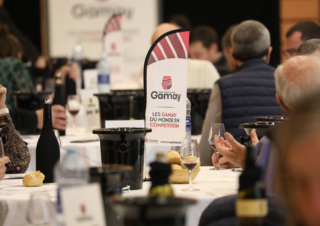
While anyone can enjoy wine tastings, professionals in the industry have largely adopted a specific method. They use sight, scent and taste to assess wine. Would you like to taste test wine like a pro but don’t know how? In this blog post, we share the three key steps to analytical wine tasting.

How the pros taste test wines
Most wine professionals have adopted what is called an “analytical” tasting method. It’s a protocol that allows them to analyse wines using their senses in a given order. Sommeliers, wine merchants, restaurant owners, winemakers and oenologists sometimes taste several cuvées in a short space of time. Some tasters try more than 100 wines in just one day! This is how they do it, they:
- observe the wine once it has been poured into the glass
- smell the wine a first time
- swill the wine around the glass
- smell the wine a second time
- bring the wine up to their mouth
- aerate the wine in their mouth
- spit the wine into a spittoon
First, observe before drinking
Before tasting a wine, start by looking at it. To do this, hold the glass up to the light or against a white background, at eye level. Its colour and clarity, or lack thereof, are the first indicators available to us. In French, this is referred to as the wine’s “robe”. The limpidity of a wine will suggest a certain lightness on the palate. An orange or brick-coloured hue may indicate that the wine is old.
This observation phase plays a crucial role in what it will later feel like on the palate. “Sight can be both interesting and dangerous. It is our strongest sense, it tends to distort the other senses,” explains Méven Otheguy, researcher in sensory analysis at the Sicarex Beaujolais / IFV (French Vine and Wine Institute). He recommends blind-tasting wines by placing the bottle in a sleeve or using tinted wineglasses.


The best blind-tasting exercise is to try to guess the colour of a wine. You’ll see that it is much more difficult than it seems, but it is a great way to appreciate how much sight can influence our other senses!
For tips and tricks from an expert, read the following article: “How to taste test wine: an expert’s tips and tricks”
Second step: bring the glass up to your nose to better discover its profile
The second step consists in smelling the wine twice. First, when the wine has just been served, bring the glass up to your nose and focus on what the aromas remind you of. This is called the “first nose”. It can be fruity, flowery or woody flavours. Next, swill the wine around the sides of the glass, this releases the aromas. Bring the glass back up to your nose and 9 times out of 10, this second time allows you to perceive new aromas. The wine aroma wheel shown opposite, from the Dico du Vin website, may help you identify them…

The best way to train your nose to perceive different flavours and aromas is to smell everything: the flowers you buy, the fruit you peel, the spices you cook with…
Step 3: on the palate

Finally, we taste wine by taking a sip and “chewing” it, this means swishing it around your mouth like when you clean your teeth. “This puts the wine in contact with all of our sensory receptors. The ones on our gums and cheeks allow us to feel heat, freshness or bitterness,” explains Méven Otheguy. Different parts of our tongues detect sweetness, acidity, saltiness, sourness and so on. To fully experience the flavour of a wine, it needs to come into contact with the entire mouth (see image).
Once on the palate, we also want to determine the texture of the wine, “the mouthfeel”. Is it supple, light, fluid? Or on the contrary, is it dense, structured, astringent?
Next, wine tasters often draw in a small breath of air while holding the wine in their mouths. In French, this is called “grumer”. “This creates a pathway for the aromatic molecules to travel toward the nose via the nasal passages,” adds the researcher in sensory analysis. In other words, this technique allows you to detect the aromas on the palate even more clearly. To perfect this technique, we recommend practising in the shower.

Wine tastings and emojis, what if we let our emotions do the talking? 👏🏼😕😍👍🏿😢😎
As well as the look-smell-taste steps that we have just laid out, why not use emojis to express your thoughts during a wine tasting? For years, the role of emotions has been ignored in wine-tasting experiences. Yet they play a crucial role in our state of mind and, consequently, in our perception of wine. Based on this observation, researchers at the IATA-CSIC in Valence, Spain studied how young consumers could use emojis as a way to express their emotional responses. Young consumers had to choose which emojis reflected their feelings when tasting a wine. “The appeal of a smiley face is that it is a universal language that transcends borders. It allows people to verbalise things that are difficult to explain and be understood by everyone,” explains Méven Otheguy.
Now that we have explained everything to you, it’s entirely up to you whether or not you adopt this professional approach to wine tasting. While it is a shared experience, wine tasting remains an intimate act, that calls on your senses and allows you to connect with your own perceptions. You must create your own “inner library”, your own personal references when it comes to wine!
For an easier way to start, read this article for our expert’s advice.